
Finding Clovis Residents Through Records
Clovis serves as the Curry County seat. That puts the main record counters near one another, even though their files stay separate. Parcel ownership and mapping data sit with the County Assessor. The County Clerk holds recorded instruments. The courts hold case files. The City Clerk keeps city-held records. So a residents directory here is really a trail across several record types, not a single public list. One narrow fact plus a record label beats any broad sweep.
Each source also has a defined purpose. A parcel names an assessed owner, not everyone living in the home. A deed lists the parties to an instrument without guaranteeing title. New Mexico's voter portal verifies one person through an identity-based workflow. It is not a street browse. Keeping those limits in mind prevents same-name errors. It also keeps a Clovis residents directory search anchored to what an official record actually says.
- For an address, locate the parcel and retain its legal description, Book/Page, and property code.
- For a recorded transfer, search the Curry County Clerk index by the parties and legal description.
- For one person, use New Mexico Case Lookup to identify a case number, court, date, and role before requesting a file.
- For a voter’s own registration or polling location, use the NMVote route and the required identifying fields.
- For a past household, ask Clovis-Carver staff for the actual directory volume, newspaper, or map lead.
Note: Log the source, date, spelling, and record limit for every Clovis residents directory lead you collect.
Clovis Resident Records Offices
Three nearby offices handle most current Clovis resident-records questions. The Clerk's recorded-document index starts online in 1986, and public terminals open the older records. The Assessor manages parcel ownership and mapping. The City Clerk handles defined city records that lack a public search screen. Staff at each counter can explain access. They will not run an open-ended person search or offer legal advice.
Curry County Clerk
417 Gidding St., Suite 130
Clovis, NM 88101
575-763-5591
Curry County Assessor
417 Gidding St., Suite 160
Clovis, NM 88101
575-763-5731
City Clerk and IPRA Custodian
321 N. Connelly St.
Clovis, NM 88101
575-763-9693
New Mexico’s Inspection of Public Records Act, NMSA 1978, §§ 14-2-1 through 14-2-12, fills the gap when a specific Clovis or Curry County record is not posted online. Anyone can file a written request. The request must describe an existing record with reasonable particularity so staff can locate it. The law does not require an office to build a new list, answer questions, or perform research on a requester’s behalf.
Clovis Parcel Records by Address
An address-based Clovis residents directory search starts with land records. The land records live in the official Curry County Map Viewer. Its Parcel Layer shows the property address, owner and co-owner fields, an owner mailing address, the legal description, Book/Page, acreage, property codes, and geometry. The property address also goes by the situs address. The mailing address, shown separately, is simply where tax mail goes. It does not prove the owner lives on that parcel.
The legal description and Book/Page form the real bridge. Carry both into the Clerk's recorded-document index or public room. According to the County, the online index covers grantor, grantee, recording date, and legal description from 1986 forward. It offers no street-address field. It offers no full image access, no sale prices, and no ownership timeline.
| Parcel field | How it helps | Limit |
|---|---|---|
| Property Address | Locates the taxed parcel | Does not list all occupants |
| Owner and co-owner | Names assessed ownership contacts | Owner can live elsewhere |
| Legal Description | Connects parcel to instruments | Needs Clerk confirmation |
| Book/Page | Creates a document-research lead | Not itself a deed image |
The official Curry County tax search screen below requires a search type plus at least four characters. That threshold nudges you toward a known tax or owner reference. Guessing at a household will not work here.
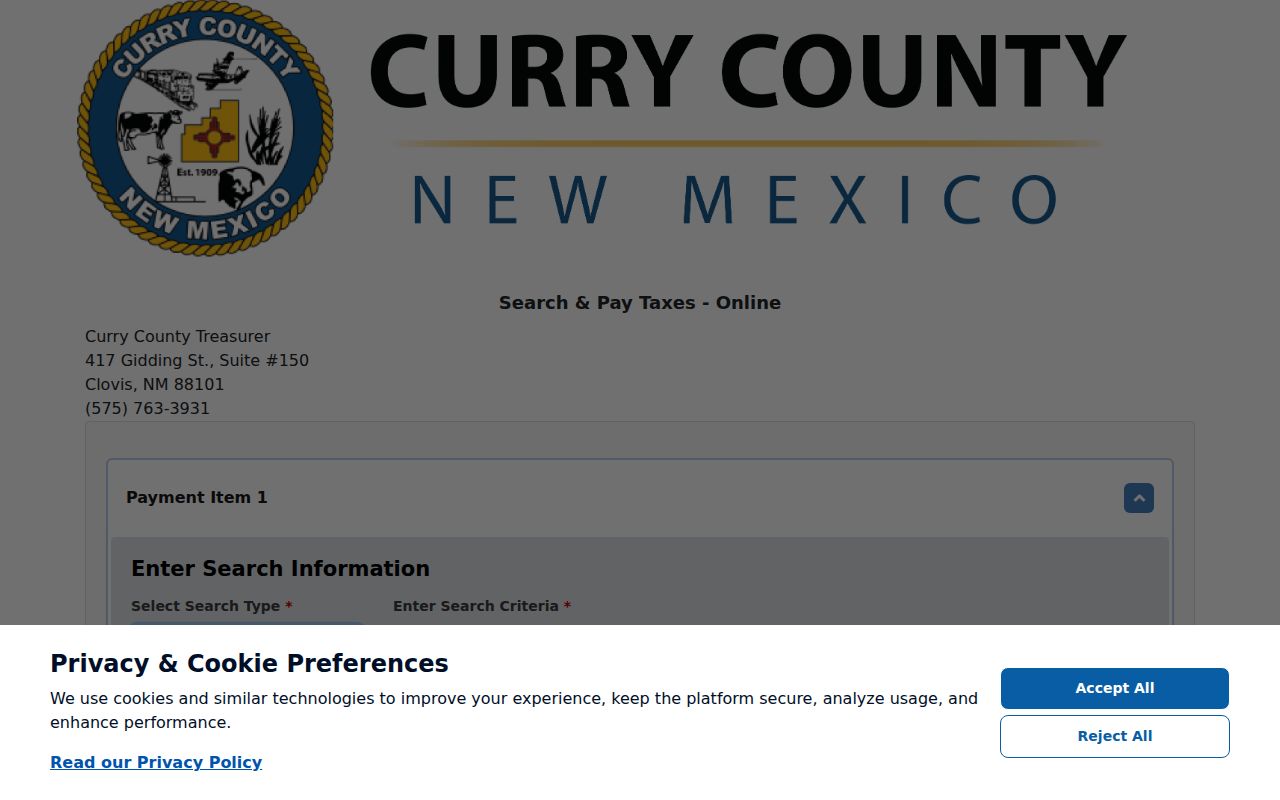
Treat the tax channel as a tool for a known bill or owner-number question. It is not a substitute for the parcel record or a current Clovis residents directory.
Clovis Residents and NMVote Limits
NMVote provides registration information, election services, and a street-number-and-ZIP tool for finding a voting location. The existing-registration interface asks for a first name, last name, date of birth, county, and a CAPTCHA. That design makes it a one-person verification path. You cannot browse Clovis residents by street there. Curry appears among the county choices in the form.
A formal voter-data request runs through the Secretary of State. The Secretary of State describes SERVIS data, an authorization form, permitted fields, and fees. The form's purpose statement and signature set that route apart from the public status check. Voter records carry protections, and ballot choices stay private. A missing match may come down to spelling, a date, county, status, or registration difference. It never proves a person is absent from Clovis.
Clovis City Files Without a Search Box
City files can add a date, project, or permit to a Clovis residents directory search. Code actions, public notices, and business-registration leads can surface there too. The City offers no verified address-results portal for every file, though. Begin at the City Archive Center. You can search by keyword, category, time period, or date range. Visible categories include business registrations, library newsletters, and calendars. Finance material, newsroom records, and police annual reports appear as well.
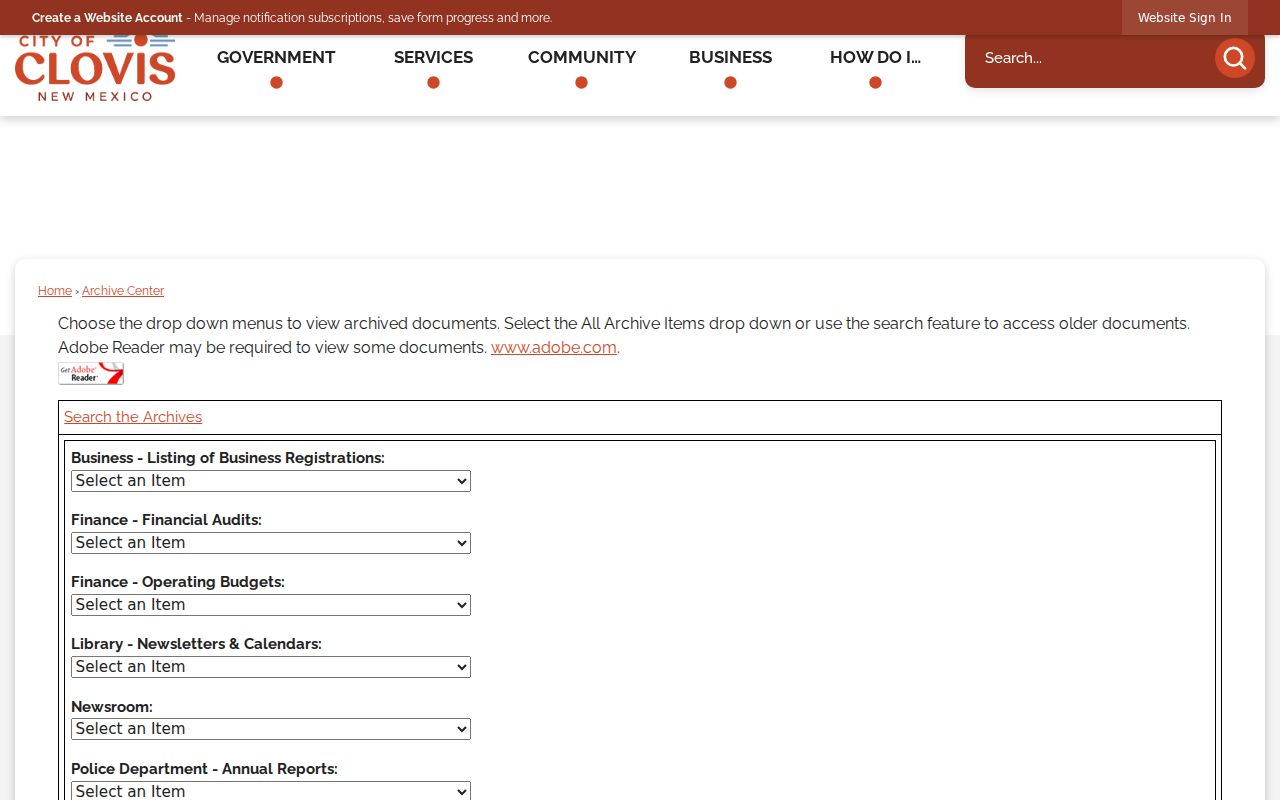
The archive search works like a pointer, not an answer. It can surface a dated City record lead and nothing more. No resident is identified by the result alone. The underlying file usually takes a focused request.
Once the archive names a specific item, shift to the City’s public-records process for the full file. The City points requesters to its NextRequest portal. Written requests can also reach the City Clerk through documented delivery channels. Include an address, department, record type, and a narrow date range. An address-linked permit, abatement, or code file can name an owner, agent, or occupant. That applies to that one proceeding only. It is not a full history of who lived there. The City’s inspection-of-public-records instructions lay out the Clerk route for a defined request.
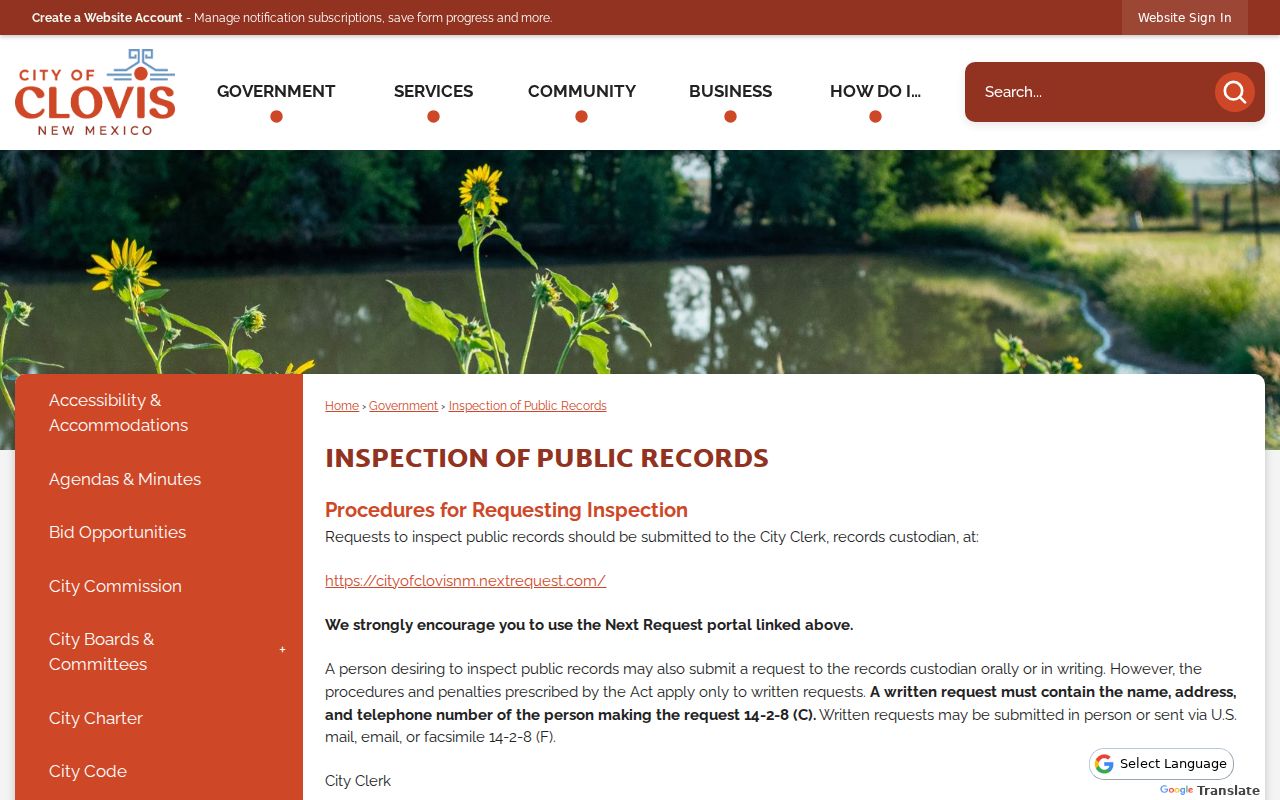
These instructions back up a records request when an online index stops short. They never turn a custodian into a private investigator. The City’s formal request portal appears alongside them.
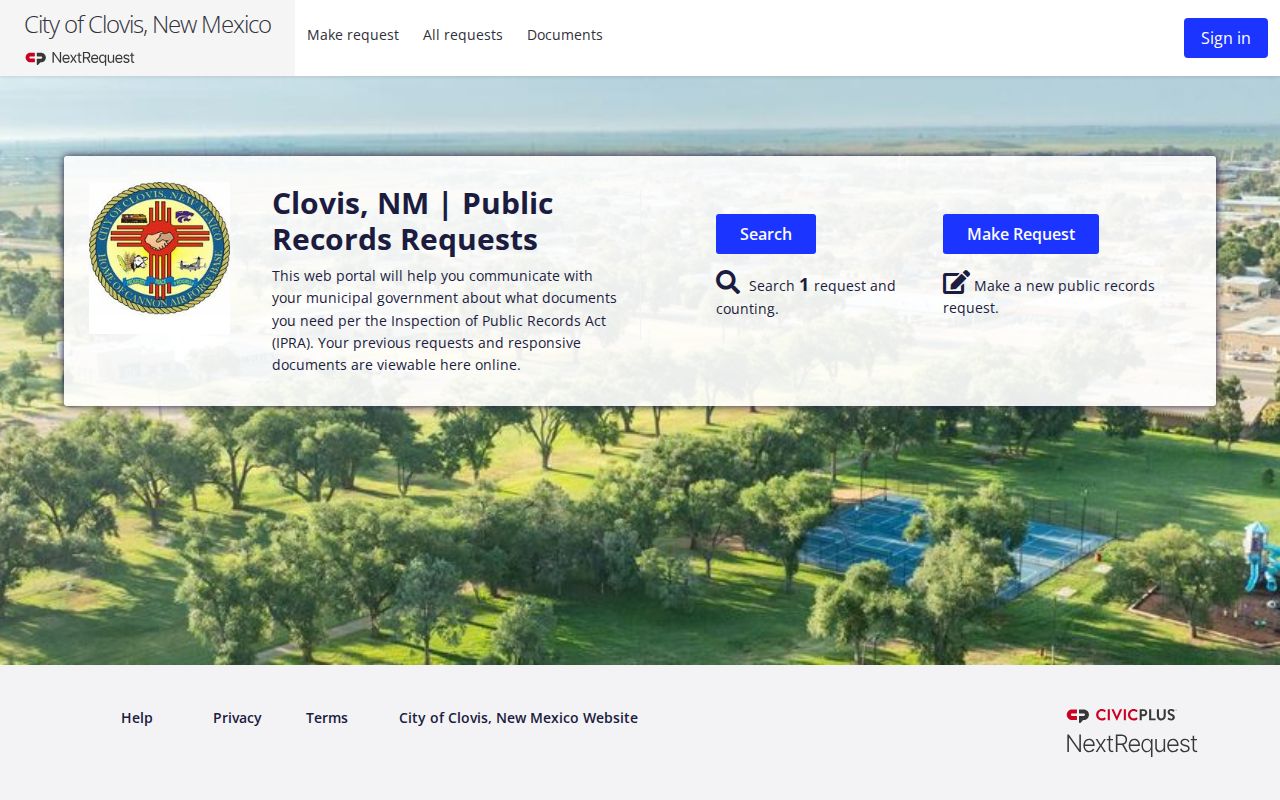
Use the portal to pinpoint an existing City-held record. Then keep the request date and the office response with the rest of your trail.
Clovis Resident Court Records
Clovis sits in the Ninth Judicial District, which covers Curry and Roosevelt counties. New Mexico Case Lookup is free and needs no registration for current electronic case information. It helps sort out a case number, case style, category, type, filing date, status, court location, and party role. Addresses and documents are another matter. The lookup does not supply them.
Registered re:SearchNM access varies by tier and restriction. For a particular file, ask the court that holds it. Ninth Judicial accepts records requests at 700 N. Main St., Clovis, while the state Judiciary IPRA portal routes a request to the responsible court. Keep the limits in mind. A case result shows that a filing occurred, not that the listed party lives in Clovis now.
Current Clovis Resident Record Sources
Treat the current side of a Clovis residents directory as several narrow sources. Each one answers a different question. Recorded documents and parcels track land interests. The voter route carries identity and access controls. Court records show case participation. City records need a focused subject, and none of these sources builds a general household inventory.
| Clovis source | What it can confirm | Keeper | Access route |
|---|---|---|---|
| Parcel Layer | Assessed owner, situs, legal description | Curry Assessor | Map viewer or Assessor counter |
| Recorded-document index | Parties, date, legal description | Curry County Clerk | Online 1986+; public terminals older |
| NMVote | One person’s registration information | New Mexico elections | Identity-field verification |
| Case Lookup | Case and party details shown online | New Mexico courts | Public index; custodian for files |
| City Archive and IPRA | Dated municipal-file leads | City Clerk | Archive search and defined request |
A name appearing in two official sources still needs a non-sensitive discriminator. Use a court location, middle initial, date, party role, or legal description. For a one-person process, use the Clovis resident lookup. It follows that confirmation sequence. It skips the street trail.
Clovis-Carver Directory Research Desk
Clovis-Carver Public Library is the local fallback for a historical Clovis residents directory search. Its Genealogy room, catalog, adult services, and posted Genealogy Workshops make it a practical place to ask. Ask there about city directories, telephone books, yearbooks, local newspapers, obituary files, and vertical files. The library is at 701 N. Main St. Hours are 9 a.m. to 8 p.m., Monday through Thursday. Friday and Saturday run 9 a.m. to 5 p.m. Sunday is closed.
Search the Clovis-Carver catalog for “Clovis City Directory,” “Polk,” a surname, a street, and related directory terms. The catalog confirms two leads. One is “Clovis City Directory.” The other is “Clovis-Portales, New Mexico : Polk city directory.” Neither entry proves a continuous year run, a reverse section, or a fixed entry format. Staff can verify the volume, publisher, year, call number, format, and abbreviation key. Always ask before relying on an entry.
Note: A printed entry is a dated household lead. It is not proof of ownership or a present address.
Clovis Residents Before County Records
A local historical trail can start before Curry County formed in 1909. The Clovis News began in 1907. The Library of Congress offers a digitized run covering 1907 to 1929. NPS documentation cites Clovis city directories for 1932, 1936, 1938, and 1941. Those are waypoints. They are not a claimed continuous collection. Read any directory or newspaper result with its date and page, and corroborate it with a custodial record when the conclusion matters.
Six cited Sanborn map years add building and block context. They cover 1909, 1912, 1919, 1929, 1951, and 1962. Maps help here. The 1912 Clovis Sanborn volume is directly available through the Library of Congress. A map gives no household names. It can still show whether an address means the same structure before a directory, deed, census, or newspaper lead is compared.
Clovis Address and ZIP Boundaries
A Clovis mailing label, a parcel, a City limit, and a ZIP code are four different geographies. 88101 is a confirmed Clovis delivery-area and post-office reference. City and County materials also use 88102 for P.O. Box addresses. Its full current postal boundary and type remain unsettled. Do not assume. Leave 88103 out of a Clovis search without current USPS or Census evidence.
Let USPS resolve the full address first. Then check the Curry parcel and the City or County boundary layer. NMVote’s street-number-and-ZIP tool finds voting-location context, not a ZIP-wide resident list. For a historic address, carry the older street form and legal description forward; the full address route sits on the Clovis street directory page.
Clovis Resident Vital Record Routes
Birth and death certificates take a different path than most Clovis resident records. The Curry County Clerk does not issue them. New Mexico's Department of Health controls access under NMSA 1978 § 24-14-27. Birth records open to the public after 100 years. Death records open after 50 years, subject to the statute. Those clocks do not guarantee digitized, name-searchable copies. Nor do they promise a local counter with the volume you want. A Clovis resident lookup built on directories and voter rolls will not reach into these files. It simply does not touch them at all.
Restricted records require the state's documented eligibility process. For a birth copy, you need a qualifying immediate-family relationship or a tangible legal interest. You also need a photo ID, the required fields, and the stated fee or channel. Death access works the same way before the disclosure window opens. The Department of Health keeps a local office at 1216 Cameo Street. The state's central vital-records site publishes the official birth and death instructions. Marriage copies stay with the issuing Curry County Clerk. Divorce files sit with the court that heard the case.
Treat these as event records, not a way to search current Clovis residents. Request only the specific record and its access procedure from the custodian.
Historical Clovis Resident Directories
Old Clovis directories reward a shelf-and-counter approach. The National Park Service cites 1932 as the earliest known Clovis directory and lists 1936, 1938, and 1941 in its historic documentation. The High Plains Historical Foundation is a local access lead worth calling, though you should confirm its holdings before counting on a particular volume. The library, the museum, the Library of Congress, and the custodian offices form a stronger chain than any single name hit in one old street directory.
An unfamiliar address deserves both forms. NPS uses the historic City Hall example of 308 Pile Street and Original Townsite Block 50, Lot 22. That pairing shows why an older source may speak in block-and-lot language rather than street names. The Clovis city directory collections support the detailed reading and tracing work that past residents of Clovis research demands.
Clovis Resident Privacy and Corrections
Every Clovis resident-records system draws its own privacy line. Case Lookup omits addresses, SSNs, and public document images. Voter law shields SSNs, agency codes, day and month of birth, and any opted-out phone number. Vital records stay restricted under NMSA 1978 § 24-14-27, with births public after 100 years and deaths after 50, subject to the statute. The vital-records route runs through the Department of Health, not the Curry County Clerk.
New Mexico Safe at Home gives qualifying participants a substitute address and keeps their confidential voter addressing off public voter lists. An inaccurate official record belongs with its creator. That means the Assessor for parcel data, the Clerk or Secretary of State for voter matters, a court clerk for court information, the Department of Health for vital amendments, or the City Clerk for City files. Opting out of a commercial people-search category changes none of those government records.
Note: A protected, sealed, or missing result is a limit on access, not a basis for inferring personal facts.